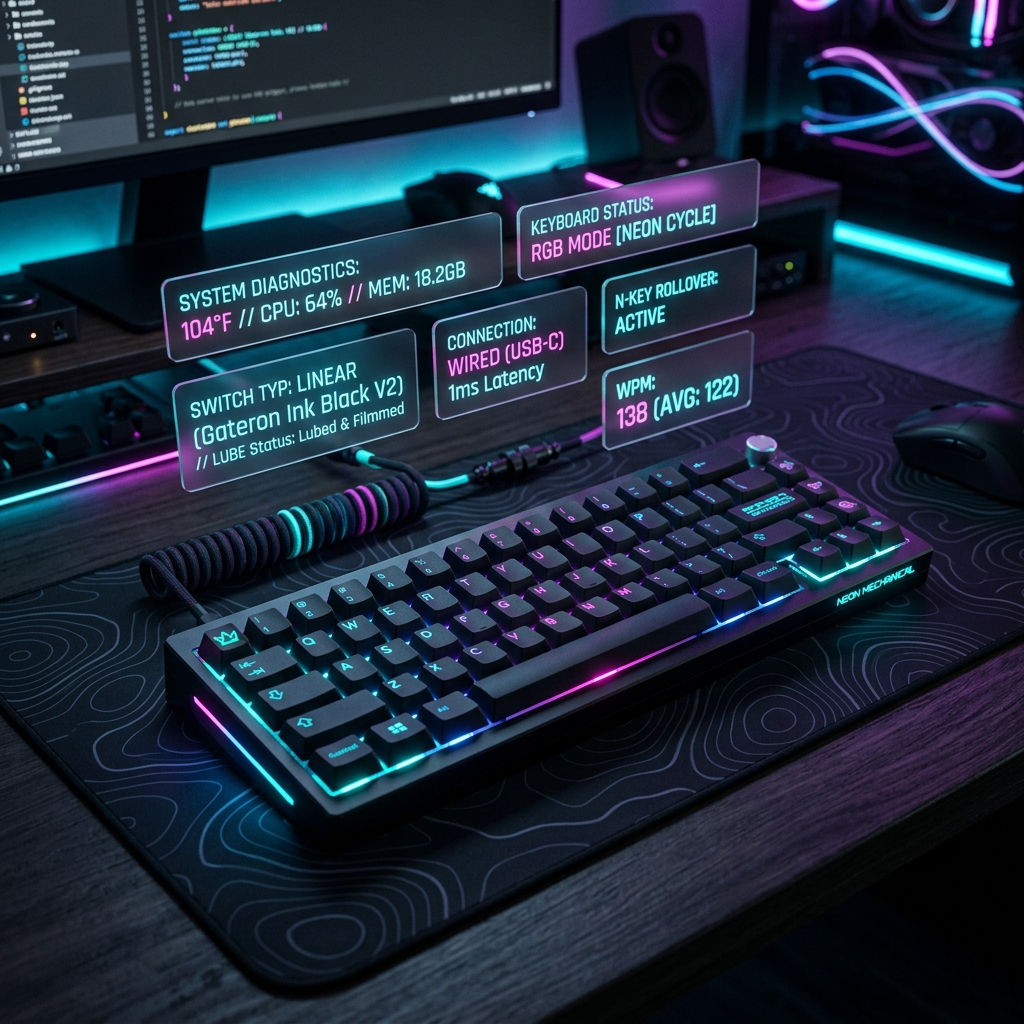
For over three decades, standard mechanical keyboard switches (pioneered by the Cherry MX architecture) dominated enthusiast and competitive setups. However, as monitor refresh rates scaled past 240Hz and 360Hz, peripheral input latency and key chatter became the primary bottlenecks in competitive gaming.
Today, two revolutionary switch architectures—Optical Light-Strike and Analog Hall Effect (Magnetic)—are rendering legacy metal contacts obsolete. In this engineering guide, we dissect the physics of contact bounce, measure real-world debounce latency, and benchmark all three switch paradigms.
1. The Physics of Switch Chatter: Why Mechanical Switches Fail
Inside every traditional mechanical switch sits a leaf spring made of copper alloy with gold-plated contact points. When you press a key, the switch stem pushes the flexible leaf against the stationary terminal.
At a microscopic level, metal is elastic. When two metal points collide at high velocity, they do not instantly lock together—they physically bounce against each other for 1 to 15 milliseconds before settling. This phenomenon is known as contact bounce.
2. Optical Switches: Light Shutter Architecture
Optical switches eliminate physical electrical connections entirely. Underneath each switch on the PCB sits an infrared (IR) light emitter and a phototransistor receiver.
- In the resting position: An internal plastic stem shutter blocks the light path.
- When pressed: The stem drops, opening a light tunnel that allows the infrared beam to strike the sensor instantly.
- Zero Contact Bounce: Because photons don't bounce, the switch requires 0ms debounce delay. Actuation latency drops from ~15ms down to 0.2ms.
3. Hall Effect (Magnetic) Switches & Rapid Trigger
Hall Effect switches represent the biggest leap in input technology since the invention of the membrane dome. Discovered by physicist Edwin Hall in 1879, the Hall Effect occurs when a magnetic field perpendicular to an electric current creates a measurable voltage difference across a conductor.
In a magnetic keyboard (such as the Wooting 60HE or DrunkDeer A75), each switch stem contains a miniature neodymium permanent magnet. As you press the key, the magnet descends toward a surface-mounted Hall sensor IC on the keyboard PCB. The sensor continuously measures the magnetic flux density, calculating the key's exact physical position in increments as small as 0.01 millimeters.
Why Rapid Trigger Changes Competitive Esports:
On traditional mechanical and optical switches, the reset point is fixed (typically 2.0mm). To counter-strafe in tactical shooters like Valorant or Counter-Strike 2, you have to release the key all the way up past that 2mm mark before pressing another key.
With Rapid Trigger, the keyboard firmware dynamically calculates direction of travel. The moment the key stem reverses upward by even 0.1mm, the key resets instantly. The moment you press down again by 0.1mm, it re-actuates. This cuts counter-strafing reaction latency by over 40 milliseconds, giving players a measurable hardware advantage.
4. Master Benchmark Comparison Matrix (2026)
| Specification | Traditional Mechanical | Optical Light-Strike | Hall Effect (Magnetic) |
|---|---|---|---|
| Actuation Mechanism | Metal Leaf Contact | Infrared Beam Shutter | Contactless Neodymium Magnet |
| Physical Contact Wear | High (Oxidation & Friction) | None (Zero Electrical Wear) | Zero (No Contact Parts) |
| Mandatory Debounce Delay | 5 ms – 20 ms | 0 ms | 0 ms (Algorithm Filtered) |
| Switch Chatter / Double Click | Common (6–18 months) | 0% (Physically Impossible) | 0% (Contactless Sensor) |
| Adjustable Actuation Point | Fixed (e.g. 2.0mm) | Fixed or Dual-Level | 0.1mm – 4.0mm (Per-Key) |
| Rapid Trigger Support | Not Supported | Limited Firmware Simulation | Native True Analog (0.1mm) |
| Rated Click Lifespan | 50 – 80 Million | 100 Million | 150+ Million (Indefinite) |
5. How to Test Your Switches for Chatter in Your Browser
If you suspect your mechanical keyboard or mouse is suffering from switch bounce chatter, you do not need to download third-party software. You can audit your switch timings directly in your web browser:
- Open the free InputTest Keyboard Switch Chatter Tester.
- Press and release keys naturally as you type.
- Our client-side listener records the microsecond delta between keydown and keyup events.
- Any consecutive event under 30ms is automatically flagged as electrical contact chatter.
Frequently Asked Questions (FAQ)
Can compressed air fix mechanical switch chatter?
Compressed air can blow out stray dust or hair resting between contacts, which temporarily resolves chatter in ~30% of cases. However, if chatter is caused by surface oxidation or metal fatigue, the switch must be desoldered or hot-swapped.
Are Hall Effect keyboards allowed in professional esports tournaments?
Yes, Hall Effect keyboards with Rapid Trigger are tournament-legal in major leagues including the VCT (Valorant Champions Tour) and ESL CS2 events. However, automated macro scripts like "Snap Tap" or "SOCD" that automate opposing directional inputs have been restricted by Valve.
Can I put Hall Effect switches into a regular mechanical keyboard?
No. Regular mechanical keyboards use two metal solder pins or hot-swap sockets to complete an electrical circuit. Hall Effect switches have no electrical pins—they require a dedicated PCB with Hall sensor ICs underneath every key slot.